As premier Soft Silk Sarees Manufacturers in Sirumugai, Sri Murugan Silk House proudly preserves centuries-old South Indian textile traditions. The renowned handloom weaving cluster of Sirumugai, situated near the textile city of Coimbatore, is globally celebrated for brilliantly combining intricate artisan craftsmanship with precise Jacquard motif technology to create timeless, heir-loom quality soft silk sarees. For decades, this geographic region has been the beating heart of Tamil Nadu’s silk weaving industry, providing livelihoods to thousands of skilled weaver families.
Understanding the complex manufacturing process highlights the immense human skill, patience, and unwavering dedication required to create just a single six-yard saree. It transforms a simple piece of clothing into a wearable piece of art. Step inside our Sirumugai weaving workshops to explore the mesmerizing 6-step manufacturing journey, tracing the saree’s evolution from raw mulberry yarn to a finished, radiant masterpiece.
The Heritage of Soft Silk Sarees Manufacturers in Sirumugai
For several generations, the traditional weaving families in Sirumugai have perfected the delicate art of low-twist mulberry silk weaving. Unlike automated machine production, handloom weaving requires an intimate understanding of yarn behavior, tension, and color dynamics. Leading Soft Silk Sarees Manufacturers in Sirumugai, like Sri Murugan Silk House, maintain strict, uncompromising quality control at every single phase of production—from the initial raw yarn sourcing to the final Silk Mark certification. We blend age-old techniques passed down from master weavers with contemporary design sensibilities to cater to the modern woman, ensuring that the legacy of Sirumugai handlooms continues to thrive in the modern fashion landscape.
6 Step Process Followed by Soft Silk Sarees Manufacturers in Sirumugai
Step 1: Pure Mulberry Raw Silk Filament Sourcing
The journey begins with selecting the finest raw materials. Leading Soft Silk Sarees Manufacturers in Sirumugai source exclusively high-grade, pure mulberry silk filaments, typically from authorized sericulture farms in Karnataka. Before any processing begins, these raw yarn threads are meticulously inspected by experts for uniform thickness, high tensile strength, and natural shine. Only premium grade silk that passes these rigorous quality checks is approved for the loom.
Step 2: Eco-Friendly Yarn Degumming & Vat Dyeing
In its raw form, silk feels stiff because it contains a natural protective protein called sericin (silk gum). To reveal the silk’s signature buttery softness, the yarns undergo a careful degumming process, where they are boiled in specialized hot soap baths. Once softened, the yarns are hand-dyed in small, controlled batches. Artisans use eco-friendly, azo-free color dyes, immersing the threads in boiling vats to produce deep, rich, and fade-resistant hues. The dyed yarns are then hung to dry naturally in the warm South Indian sun.
Step 3: Warping Bed Assembly & Bobbin Winding
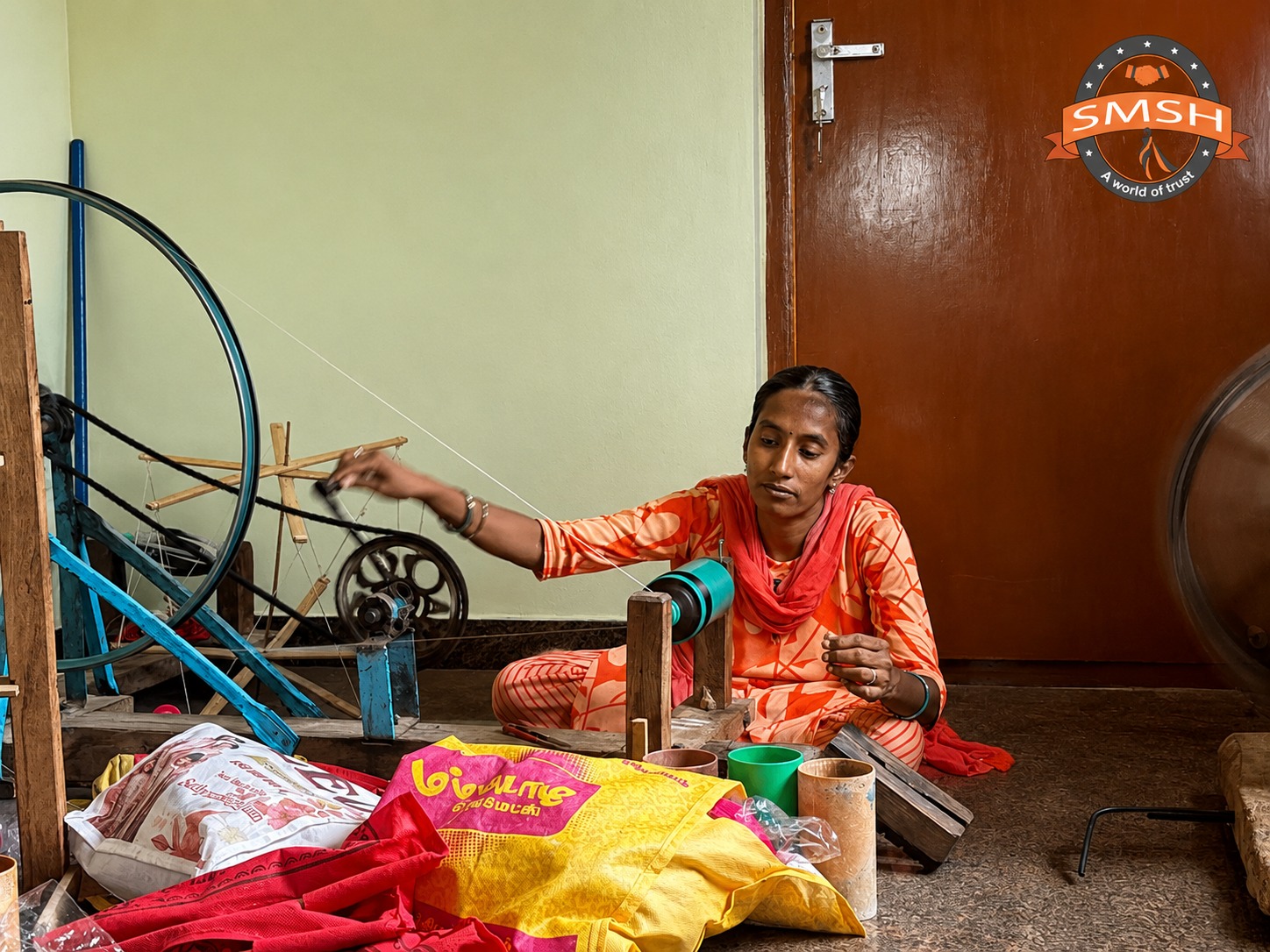
After drying, the colored silk threads are spun onto small wooden bobbins using traditional spinning wheels. These threads are then stretched across massive wooden warping frames to assemble the long warp thread bed (the longitudinal yarns). This process requires immense mathematical precision to ensure the threads are perfectly aligned and tensioned, as a single tangled thread can disrupt the entire weaving process. A typical warp is prepared long enough to weave 4 to 5 sarees consecutively.
Step 4: Jacquard Punch Card Motif Designing
The intricate designs of a Sirumugai silk saree are planned long before the weaving starts. Master design artists hand-draw traditional motifs—such as dancing peacocks, mango paisleys, intricate swans, and elaborate temple borders. These intricate patterns are then translated and punched onto hundreds of Jacquard cards. Acting like early computer programs, these punched cards are loaded onto the handloom to automatically control the lifting of the exact silk and zari threads needed to create flawless, repeating patterns.
Step 5: Shuttle Pass Handloom Weaving
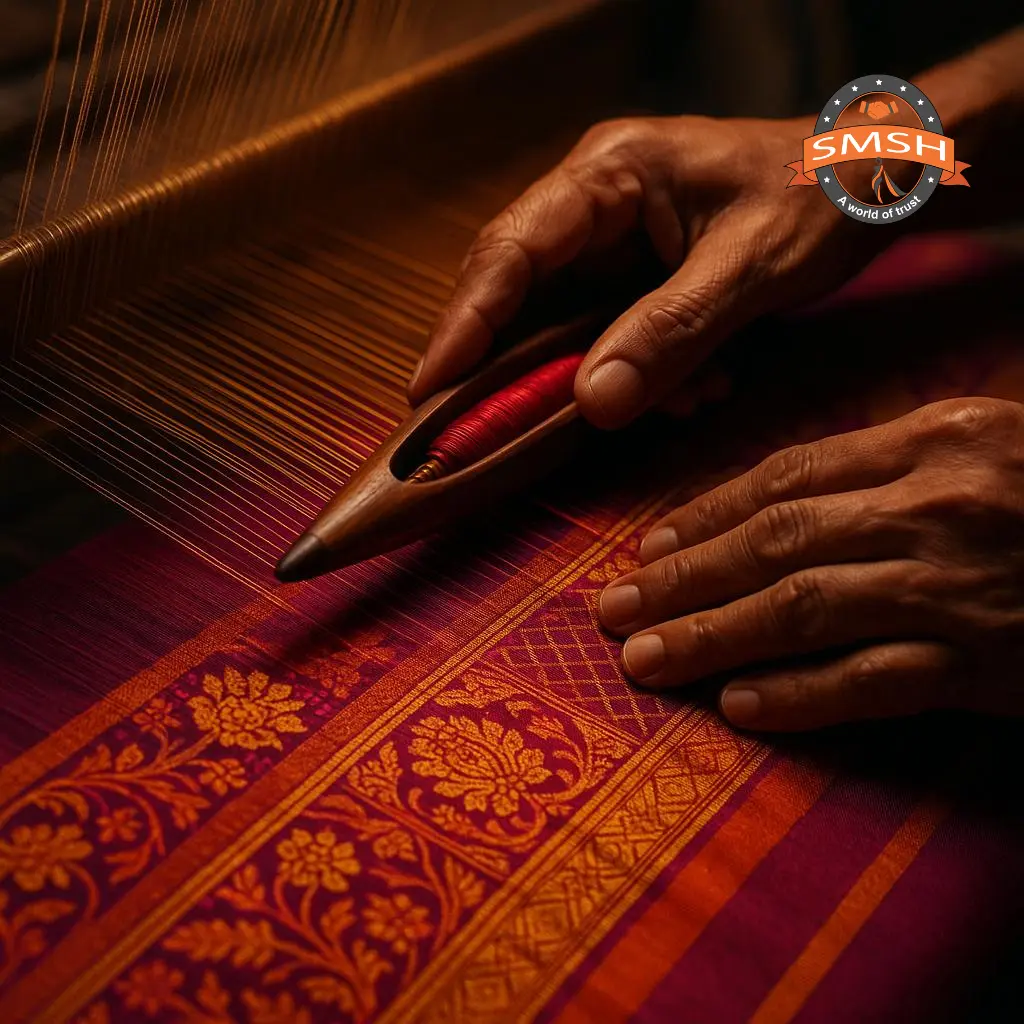
This is where the magic happens. Master weavers operate heavy manual wooden pit looms, utilizing a physically demanding process that coordinates their hands and feet. They press foot pedals (treadles) to separate the warp threads while swiftly throwing the wooden shuttle (containing the weft thread) across the loom. By interlocking the fine silk warp threads with rich gold or silver zari weft patterns, the saree slowly comes to life inch by inch. Depending on the complexity of the Jacquard design, weaving a single soft silk saree can take anywhere from 3 to 10 days of continuous labor.
Step 6: Quality Inspection & Silk Mark Authentication
Once the saree is finally removed from the loom, it is not yet ready for the showroom. Every single drape created by authentic Soft Silk Sarees Manufacturers in Sirumugai undergoes a multi-stage, rigorous quality inspection. Experts check for structural flaws, verify yarn purity, ensure color fastness, and confirm exact border symmetry. Finally, the saree is carefully folded, pressed, and affixed with the government-authorized Silk Mark India hologram tag—the ultimate guarantee of 100% natural silk.
Partnering with Soft Silk Sarees Manufacturers in Sirumugai
By purchasing directly from an authentic weaving house, retail buyers, brides-to-be, and boutique owners receive premium factory rates accompanied by a 100% purity guarantee, entirely eliminating middleman markups. Whether you are seeking a single bespoke bridal saree or fulfilling bulk wholesale orders for your retail business, Sri Murugan Silk House is your trusted handloom partner. Learn more about our rich heritage on our About Our Manufacturing page or visit the official Ministry of Textiles handloom portal to discover how buying authentic handlooms supports rural artisan communities across India.